The Scrum Master (SM) role is not dying — it’s evolving. The “ceremony facilitator / Jira secretary” version is shrinking fast. The “delivery + systems + product-value enabler” version is growing, and AI is accelerating that evolution.
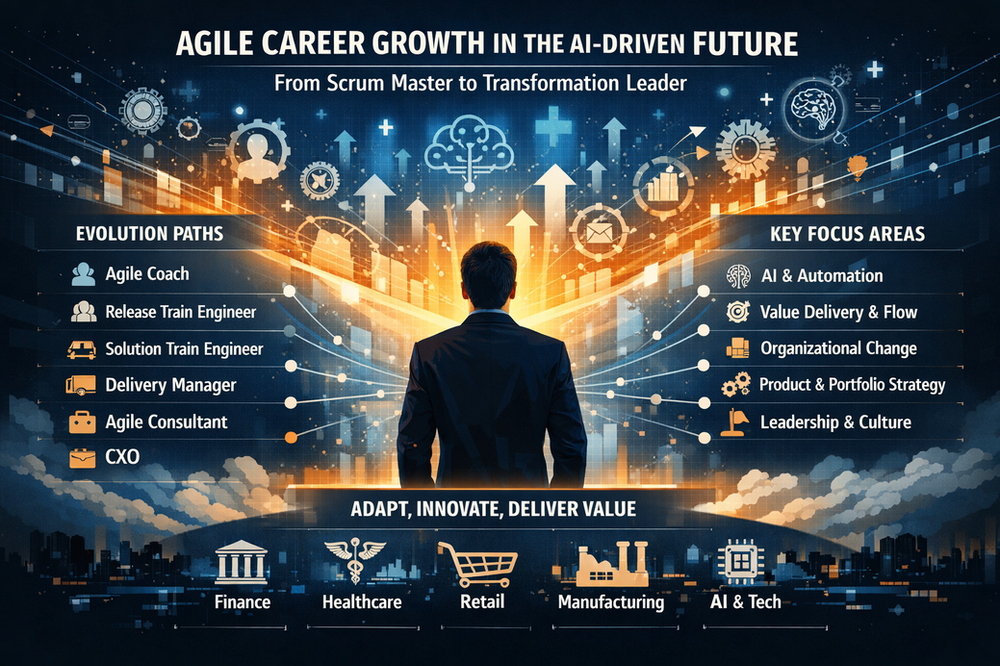
Below is a rigorous, no-fluff view of where the SM role is headed, what’s changing with AI, and how an SM can deliberately grow into Agile Coach, RTE, STE, Delivery Manager, Transformation Leader, Program Manager, and even CXO.
1) Observations about the Scrum Master role in 2026+
Observation A: The market is devaluing “basic Scrum”
Many orgs now expect:
Teams already know ceremonies
Tools are automated
Reporting is self-serve dashboards
So a “pure facilitation” SM gets questioned: “What’s the ROI?”
What’s valued instead: measurable delivery outcomes and system-level improvements:
Predictability without gaming
Better flow (cycle time, WIP, throughput)
Fewer dependencies as a result of design changes
Better product discovery + delivery alignment
Faster decision-making and less coordination overhead
Observation B: Organizations are shifting from “Agile adoption” → “Agile as a business operating system”
Agile is no longer a methodology project; it’s a survival strategy:
shorter product cycles
faster customer feedback
ability to pivot without chaos
ability to innovate while running the business (KTLO + change)
Observation C: AI is pushing organizations toward faster change cycles
AI creates:
Faster experimentation (prototypes, A/B testing, content generation)
Faster software delivery (copilots, automation, test generation)
More frequent product updates (weekly/daily)
That means coordination, governance, risk, and value-management become even more important — which is exactly where an evolved SM thrives.
2) A skeptic’s counterpoint (important)
A well-informed skeptic will say:
“Agile has become buzzword theatre in many companies.”
True. If leadership uses Agile to push speed without clarity, it becomes chaos.
“AI will replace SM work.”
AI will replace low-leverage SM work (status chasing, basic notes, basic reporting).
But AI increases the need for human influence + decision facilitation + organizational change.
“Frameworks like SAFe are too heavy.”
Sometimes yes. If applied blindly, they create bureaucracy.
But at scale, the problem is not Scrum—it’s coordination economics. The right amount of structure can reduce total cost of delay.
So the conclusion isn’t “Agile everywhere.”It’s: organizations that learn fastest win, and Agile (done right) is still one of the best operating models for learning fast.
3) Prediction: What will happen to Agile with AI?
Agile gets more push, but changes shape.
AI compresses delivery cycles, so companies must optimize for:
value throughput, not activity throughput
fast learning, not just fast coding
safe speed, not reckless speed
Agile will evolve toward:
Flow and outcome metrics as default (not optional)
Continuous discovery + delivery
Smaller bets, faster validation
Stronger product management discipline
Better systems thinking (bottlenecks, constraints, dependency reduction)
4) Why management is obsessed with “value” now
Because markets punish slow organizations:
Customers switch faster
Competitors copy faster
Product differentiation decays faster
Cost of delay gets brutal
So leadership focuses on:
time-to-market
customer retention and NPS
cost efficiency + reliability
innovation without destabilizing operations
Agile becomes significant because it gives:
feedback loops
prioritization discipline
transparency into work
adaptability without losing control
5) Agile significance across industries (how it shows up differently)
Industry | “Value” usually means | Agile shows up as | SM/Coach impact focus |
Banking/FinTech | risk-managed releases, compliance, faster features | portfolio governance + secure delivery | dependency mgmt, flow, risk & controls alignment |
Healthcare | safety, regulatory compliance, patient outcomes | disciplined product increments | predictability + quality + stakeholder alignment |
Retail/eCommerce | conversion, revenue, experimentation speed | high-velocity experimentation | A/B testing cadence + customer journey alignment |
Manufacturing/Auto | cycle time, quality, cost reduction | Lean + Agile + systems engineering | flow + supplier dependency + release governance |
Telecom | reliability + rapid feature updates | platform/product operating model | KTLO vs change balancing, SLO/SLA alignment |
Government | transparency + incremental delivery | staged funding + incremental outcomes | governance, stakeholder mgmt, clarity of outcomes |
AI/ML Products | model performance + responsible AI | experimentation pipelines + MLOps | experiment design, evaluation cadence, ethics/risk |
Agile is not just “Scrum.” It’s a mindset + operating model to disrupt markets by learning faster than competitors.
6) Career growth map for an SM (real pathways)
The reality: growth happens when you “own a bigger system”
Not just one team’s ceremonies — but outcomes, dependencies, governance, and change.
Here’s a practical map:
Next Role | Core purpose | What you must become great at | Proof of readiness |
Senior Scrum Master / Delivery Lead | predictable delivery + flow | metrics, risk, dependency mgmt, stakeholder mgmt | stable predictability, improved cycle time, fewer surprises |
Agile Coach | capability building across teams | coaching, org change, facilitation at scale | multiple teams improved, leaders changed behaviours |
Release Train Engineer (RTE) | execution + alignment of ART | PI execution, dependency mgmt, program metrics, facilitation | smooth PI, reduced cross-team blockers, reliable releases |
Solution Train Engineer (STE) | multi-ART coordination | systems thinking, lean portfolio alignment, governance | integrated planning, reduced solution-level risks |
Delivery Manager / Program Delivery Lead | accountable delivery outcomes | scope/value mgmt, financials, risk, roadmap execution | delivery success across multiple streams |
Agile Consultant | advisory + transformation outcomes | diagnosis, operating model design, executive influence | transformation roadmap + measurable adoption outcomes |
Agile Transformation Leader / LACE Head | enterprise transformation | strategy, change mgmt, capability building | improved business outcomes tied to Agile changes |
Agile Program Manager / TPM | complex program execution | roadmap, dependency, financials, governance | predictable program delivery with measurable outcomes |
CXO track (COO/CPO/CTO) | strategy + operating model | business model, portfolio, talent, execution system | P&L thinking, strategic prioritization, org design |
7) What AI changes for each role (what to lean into)
What AI will automate (don’t build your identity here)
meeting notes, action items
basic Jira hygiene
status report drafts
simple dashboards
drafting comms and templates
first-pass risk logs and dependency lists
What AI will not replace (this becomes your edge)
influencing leadership trade-offs
resolving conflict and misalignment
designing org systems (governance, operating model, incentives)
sensemaking under ambiguity
negotiating dependencies and priorities
coaching behaviour change
ethics, trust, and culture shaping
So your growth strategy: use AI to remove low-value work and reinvest time into high-leverage leadership work.
8) The “new Scrum Master” capability stack (the one that wins)
Think of it as 4 layers:
1) Team Excellence (baseline)
facilitation, coaching, team dynamics
Scrum/Kanban practices
quality mindset, DoR/DoD discipline
2) Delivery Excellence (where demand is rising)
flow metrics: cycle time, throughput, WIP, aging work
predictability without manipulation
dependency mapping and resolution
risk management with leading indicators
3) Product & Value Enablement (rare and powerful)
customer journey thinking
outcome-based planning (OKRs, measurable value)
slicing work to validate value early
cost of delay thinking
4) Organizational Systems (what makes you “coach/RTE/leader”)
operating model design
governance that enables speed safely
incentives and performance systems alignment
portfolio prioritization and capacity allocation
9) Practical growth plan (SM → Coach/RTE/Leader)
0–3 months: “Stop being a ceremony owner”
Build a metrics narrative: predictability, flow, quality, outcomes
Create a visible dependency system (board + owners + due dates)
Use AI to automate reporting so you can focus on decisions
3–9 months: “Become a delivery leader”
Drive 2–3 measurable improvements:
reduce cycle time by X%
improve predictability by X%
reduce escaped defects by X%
Build stakeholder trust through clear trade-offs and transparency
9–18 months: “Operate at program level”
Facilitate multi-team planning
Drive cross-team risk management
Learn portfolio thinking: capacity, cost of delay, prioritization economics
18–36 months: “Lead transformation”
Diagnose org constraints
Propose operating model improvements
Coach leaders, not just teams
Tie change to business outcomes
10) Common traps (that will block growth)
Agile = Scrum ceremonies
No. Agile = value delivery + learning system.
Metrics = velocity
Velocity is a team-local output measure; it’s easily gamed. Flow + outcome metrics are harder to fake.
RTE = bigger Scrum Master
Wrong. RTE is a program execution leader + systems integrator.
Transformation = training + templates
Transformation is behaviour + incentives + operating model + leadership decisions.
11) The mindset that creates “disruptors”
Agile gives people and organizations:
permission to experiment
discipline to prioritize
courage to kill weak bets early
tools to reduce time-to-learning
habits that build adaptability
That’s how disruption happens: not by big plans, but by faster validated learning.
Role of LIVE PROJECT LEARNING
Scrum Master mentorship on live projects plays a crucial role in developing capable Agile leaders who can drive organizational success. By bridging the gap between theory and practice, mentors empower Scrum Masters to get new JOB offers and to excel in their roles, foster innovation, and lead teams towards achieving higher levels of productivity and collaboration. As Agile methodologies continue to evolve, investing in mentorship becomes not just beneficial but essential for individuals and organizations committed to Agile excellence.
In essence, the journey of a Scrum Master is not just about mastering frameworks—it's about harnessing mentorship to cultivate skills, inspire teams, and navigate the complexities of Agile project management with confidence and competence.