What after PSPO I? · Free career guide
From PSPO I to job-ready Product Owner
Congratulations on passing PSPO I. You have proved you understand product ownership in Scrum. Here is the step-by-step path that turns that knowledge into the skills, live-project experience and interview stories that get Product Owner and Product Manager roles.
See the 6-step path · Explore the live-project mentorship · Join the next free webinar
- 4,000+ learners guided in 40+ countries
- Live classes, recording of every class
- Small cohorts of about 4–6 learners
- Verified learner success stories
Your path after PSPO I, in 6 steps
Follow the steps in order. Steps 1 to 3 are free. Step 4 is where most learners get stuck on their own, so it is the one we help with most.
- See the whole delivery system: How products really go from idea to customer, and where the Product Owner and AI fit. Free · this page
- Check your skills: Tick the 32 Product Owner skills you can already show, and see the gaps. Free self-check
- Network with Agilists: Attend a free live webinar, ask your questions and meet Product Owners, Scrum Masters and Agile coaches. Free webinar
- Practise on a live project (most important step): Take one product from an unclear request to a measurable release in Jira, with a coach and AI tools. Live mentorship
- Prove it in interviews: Turn your product work into a case study and confident interview answers. Portfolio + mock interviews
- Add the right SAFe certification: Pick the SAFe course that matches the role you want. By role
Why passing PSPO I rarely gets you hired on its own
PSPO I shows you understand product ownership well enough to pass a demanding assessment. Interviewers ask which product decisions you have actually made. That gap is what stops most new PSPO I holders.
What your PSPO I gave you
- A solid grasp of the Product Owner accountability
- Value, the Product Goal and the Product Backlog
- Judgement on exam-style scenarios
- A lifetime credential on your profile
What interviewers ask you to show
- Writing user stories and acceptance criteria in Jira
- Ordering a backlog with clear reasons
- Handling stakeholders who all want to be first
- Planning an MVP and a release
- Tracking product metrics and adapting from feedback
- Using AI tools in product work
- Specific stories from products you have worked on
These come from practice, not from a two-day course. The steps below show how to build them.
Step 1: See the whole delivery system, with AI
Scrum covers how one team turns a Product Backlog into a valuable Increment. Real product delivery is wider: ideas are funded, discovered, shaped into an MVP, refined, planned across teams, built, released and measured. Here is the whole chain, the Product Owner's part in each stage and where AI helps today.
- Strategy and vision. Leaders set business goals, OKRs and product vision; portfolio work is funded and prioritised. Your part: Turn business goals into a clear product vision and a Product Goal the team can rally around. AI helps: Summarise market and competitor research, draft vision statements and OKR options to discuss.
- Discovery. The team tests problems and ideas with real users before building much. Your part: Talk to customers, frame value hypotheses and decide what is worth building first, often as an MVP. AI helps: Cluster interview notes, draft personas and journey maps, and suggest experiments to test assumptions.
- Product Backlog and refinement. Ideas become epics, features and user stories with acceptance criteria, ordered by value. Your part: Own and order the Product Backlog, write clear stories and acceptance criteria, and lead refinement. AI helps: Draft user stories and Given/When/Then scenarios, flag vague items and propose splits for you to check.
- Prioritisation and roadmap. Competing requests are weighed by value, risk, urgency, dependencies and cost of delay. Your part: Make trade-offs visible, say no with reasons and keep a roadmap that stakeholders understand. AI helps: Compare options against your scoring model and draft trade-off summaries for stakeholder conversations.
- Planning (Sprint and multi-team). Teams plan a Sprint; on larger products, many teams plan together, as in SAFe PI Planning. Your part: Bring a clear objective to Sprint Planning, answer questions and agree a realistic Sprint Goal with the team. AI helps: Summarise capacity and past flow data, list dependencies and challenge planning assumptions.
- Build, test and accept. Developers build and test the work against the Definition of Done. Your part: Stay available, clarify intent, inspect work early and accept it against the acceptance criteria. AI helps: Generate test ideas from acceptance criteria and summarise open questions from the team.
- Release. Done work is deployed; releases are planned, communicated and sometimes switched on with feature flags. Your part: Decide what to release and when, check release readiness and communicate changes to users and stakeholders. AI helps: Draft release notes, change summaries and stakeholder updates from completed work.
- Measure and learn. The product runs in production; teams watch adoption, satisfaction and business results. Your part: Bring evidence to the Sprint Review, track product outcomes, and adapt the Product Backlog and roadmap. AI helps: Summarise usage analytics, feedback and support tickets, and spot trends in your product metrics.
See how Scrum fits inside this chain
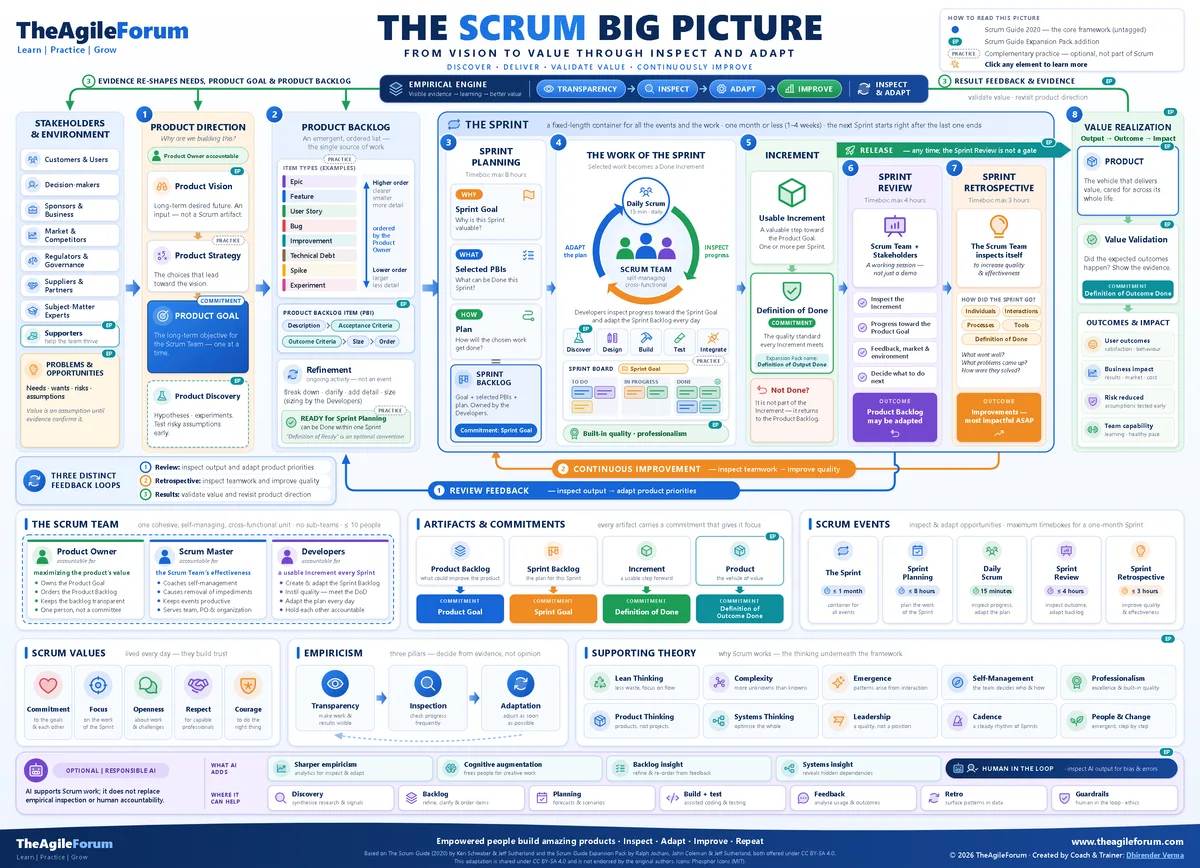
The Scrum Big Picture shows the Product Backlog, every event, the accountabilities and the three feedback loops on one page. Open the interactive Scrum Big Picture for 111 guided lessons and a 52-decision Sprint simulation.
Responsible AI: Use AI as an assistant, not a decision-maker: keep company data in approved tools and have people check every output.
Based on the Scrum Guide 2020 and the Scrum Guide Expansion Pack. Shared under CC BY-SA 4.0.
Step 2: Check your 32 Product Owner skills
A two-day certification covers the minimum Product Owner knowledge. Being an effective Product Owner takes a much wider set of skills across product thinking, backlog and delivery, and people. Tick the ones you can already show with an example.
Product thinking skills
Deciding what is worth building.
- Product vision: Describe where the product is going and why it matters to customers.
- Product Goal: Set a clear, measurable objective the Scrum Team can work towards.
- Customer discovery: Interview users and learn what problems they really have.
- Value hypotheses: Turn ideas into testable assumptions about customer and business value.
- MVP thinking: Define the smallest release that tests the riskiest assumption.
- Market and competitor awareness: Know the alternatives your customers already use.
- Business model understanding: Know how the product earns money or saves cost.
- Roadmapping: Plan outcomes over time without promising fixed dates for everything.
- Product metrics: Track adoption, engagement, satisfaction and business value.
- Data-informed decisions: Use evidence, not opinion, to change direction.
Backlog and delivery skills
Turning decisions into valuable Increments.
- Product Backlog ownership: Keep the backlog visible, ordered and understood by everyone.
- User stories: Write stories that describe who needs what and why.
- Acceptance criteria and BDD: Write Given/When/Then scenarios, including edge cases and business rules.
- Story splitting: Slice large items into small, valuable pieces.
- Prioritisation techniques: Use MoSCoW, value scoring and cost of delay with reasons.
- Backlog refinement: Lead refinement so items are clear enough to plan.
- Sprint Planning: Bring a clear objective and help the team agree a Sprint Goal.
- Acceptance decisions: Inspect work early and accept it against agreed criteria.
- Release planning: Forecast releases, manage scope and check release readiness.
- Risk and dependency management: Spot risks and dependencies early and agree owners.
- Jira and Confluence: Run a backlog, versions and dashboards; keep decisions documented.
- Responsible AI use: Use AI for drafts and analysis while you validate every output.
People and influence skills
Working with the team and stakeholders.
- Stakeholder management: Map stakeholders and keep their expectations realistic.
- Saying no well: Decline or defer requests with clear reasons tied to value.
- Negotiation: Find trade-offs that stakeholders can accept.
- Collaboration with the Scrum Master: Work as partners, each with a different accountability.
- Working with Developers: Explain the why and trust the team to decide how.
- Facilitation: Run workshops and Sprint Reviews where real feedback emerges.
- Product demos: Show working product and ask questions that get useful feedback.
- Communication: Adapt the message for executives, the team and customers.
- Decision-making: Make timely decisions and explain them.
- Empathy: Understand customer and stakeholder needs behind their requests.
Step 3: Network with Agilists and attend a free webinar
A certificate can start a conversation; relationships keep it going. Come to a free live webinar with a question, meet Scrum Masters, Product Owners and Agile coaches, and leave with one idea to try.
Join The Agile Forum's next live webinar
Free Scrum Master, Agile project management and Product Owner sessions. Check the registration page for the next date and time.
- Ask a scenario-based question in the Q&A.
- Meet fellow learners and swap practical resources.
- Turn one insight into a practice experiment.
Register for the next free webinar
A simple networking rhythm
- Week 1: Attend a live webinar, write three takeaways and ask one question.
- Week 2: Talk to a practising Scrum Master about a real obstacle.
- Week 3: Join a Scrum community meetup or discussion and contribute one insight.
- Week 4: Publish a short reflection or case study and follow up with two peers.
A thoughtful first LinkedIn message: “Hi [Name], I enjoyed your perspective on [specific product challenge]. I recently passed PSPO I and am practising backlog and MVP decisions on a practice product. I'd value one suggestion on how you approach [real problem]. Thanks for sharing your experience.”
- Scrum Alliance events: Community gatherings, user groups and learning opportunities.
- Scrum.org community: Professional Scrum forums, webcasts and peer discussions.
- The Agile Forum Meetup groups: Local Agile, Scrum and career groups we host and support.
Step 4: Practise the job, not just the theory
The BA / PO / PM Live Project Mentorship is where you close the gap. You work on one continuous product case on your own laptop, from an unclear business request to a measurable release, with a coach beside you, so you leave with real product work to talk about.
What you practise
- Turn an unclear business request into product vision, MVP and roadmap
- Write user stories and BDD acceptance criteria in Jira
- Prioritise with MoSCoW, value scoring and cost of delay
- Lead backlog refinement, estimation and a release forecast
- Handle stakeholder conflict, negotiation and product demos
- Run Sprint Reviews, accept work and adapt the backlog from feedback
- Build a PO/PM dashboard in Jira and use AI tools such as ChatGPT, Claude and Rovo with human checks
- Present a final product case you can use in interviews
What's included
- Live, instructor-led classes — not pre-recorded videos — with a recording of every class
- Your own live project on your laptop: sprints, backlog, Scrum events and stakeholder situations
- AI tools used across the delivery lifecycle
- Rejoin the next batch free if a busy week gets in the way
- Small cohorts of about 4–6 learners. Seats per batch are limited.
- No Cost EMI over 3, 6 or 9 months for learners paying in India
- Interview readiness: real examples to talk through, plus the optional Mock Interview Series
Your trainer: Dhirender Verma — SAFe® Program Consultant (SPC), Enterprise Agile Coach and founder of The Agile Forum — or an equivalently qualified trainer.
See the mentorship and batch dates · Ask a question on WhatsApp
Not ready to decide? Join a free live webinar first and ask your questions.
Prefer to practise on your own first? Free 90-day plan and practice Sprint
Days 1–30 · Build: Build a truthful product foundation
Learn the Product Owner accountability and pick one fictional or volunteer product to practise on.
- Re-read the Scrum Guide: Focus on the Product Owner, the Product Goal and the Product Backlog.
- Pick a practice product: Choose a simple product idea and write its vision and target users.
- Talk to five people: Run short problem interviews and write down what you learned.
- Draft a Product Goal: Make it specific enough that the team could tell if they reached it.
What you can show: A product vision, a Product Goal and notes from real conversations.
Days 31–60 · Apply: Shape and order a real backlog
Turn what you learned into a Product Backlog and practise the decisions a Product Owner makes.
- Write the first backlog: Create epics and user stories with acceptance criteria in Jira or a similar tool.
- Prioritise with reasons: Order the backlog with a simple value and risk scoring model.
- Plan an MVP release: Decide the smallest release that tests your riskiest assumption.
- Run a mock refinement: Walk a peer through your stories and improve them from their questions.
What you can show: An ordered backlog, an MVP release plan and the reasons behind your choices.
Days 61–90 · Prove: Prove readiness and choose your next track
Show your product thinking with evidence and pick the next step for the role you want.
- Simulate a Sprint Review: Demo your increment or prototype and capture feedback.
- Adapt the backlog: Show what changed in the backlog because of that feedback.
- Define product metrics: Choose three outcome measures and explain how you would track them.
- Build your case study: Write an honest case study and practise interview answers from it.
What you can show: A product case study with evidence, metrics and a clear next step.
Your 10-action checklist
- Read the Scrum Guide sections on the Product Owner, Product Goal and Product Backlog.
- Study the Scrum Big Picture and its three feedback loops.
- Finish at least five Scrum Academy lessons and their knowledge checks.
- Write a product vision and a measurable Product Goal for a practice product.
- Interview five potential users and summarise what you learned.
- Write ten user stories with acceptance criteria and order them by value.
- Define an MVP release and explain what it will test.
- Simulate a Sprint Review and adapt the backlog from the feedback.
- Join one free webinar and one community discussion.
- Practise five Product Owner interview answers with feedback.
The ShopEase practice Sprint
Product Goal: make checkout reliable and easy. Example Sprint Goal: “Help shoppers recover from a failed payment without losing their cart.” A Definition of Done might cover automated tests, security checks, code review, integration and usable behaviour. The team's exact Definition of Done should be explicit and fit the product.
- Product discovery: Interview imaginary shoppers, clarify the cart-loss problem and write one desired outcome.
- Sprint Planning: Explain why this Sprint matters, select work toward a cohesive Sprint Goal and plan how to build it.
- Daily Scrum: Developers inspect progress toward the Sprint Goal and adapt the next 24 hours of work.
- Build a Done Increment: Collaborate, test, integrate and check quality against the Definition of Done.
- Sprint Review: Discuss the outcome with stakeholders, examine the Increment and adapt the Product Backlog.
- Sprint Retrospective: Inspect how the team works and pick one actionable quality or collaboration improvement.
Practise the 52-decision Sprint simulation
Step 5: Prove it: portfolio and interviews
Interviewers trust specific stories from real work. Turn what you practised into a short portfolio and answers you can give with confidence. Never present a simulation as paid job experience.
Your six-piece portfolio
- Product problem, audience, desired outcome and constraints.
- Product Goal, Product Backlog examples and the reasons for their order.
- Sprint Goal, a sample Sprint Backlog and the Definition of Done.
- Screenshots or exports of the Jira board and workflow, with explanations.
- Sprint Review insights, a Retrospective experiment and evidence of adaptation.
- Self-critique: what the simulation cannot show, and what you would validate on a real team.
Practise these interview questions
- A senior stakeholder demands a feature that does not fit the Product Goal. What do you do?
- Thank them, ask what problem they are trying to solve and what outcome they expect. Compare it openly with current priorities using your value and risk criteria. If it truly matters more, reorder the backlog and explain the trade-off; if not, explain why and when you will revisit it.
- The team delivers every Sprint, but customers are not using the new features. Why?
- Output is not outcome. Check whether you validated the problem before building, look at usage data and talk to users. Bring the evidence to the Sprint Review and adapt the backlog towards what customers actually need.
- Developers say your stories are unclear during Sprint Planning. How do you fix it?
- Invest more in refinement: explain the why, add acceptance criteria and examples, split large items and invite developers to shape the stories with you before planning.
- Two business units both say their request is the top priority. How do you decide?
- Make the decision criteria explicit, such as customer value, cost of delay, risk and dependencies. Score both requests together with the stakeholders, decide transparently and record why.
- Halfway through a Sprint, an urgent request arrives. Do you add it?
- Talk with the Developers first. If the Sprint Goal still holds, the request may wait for the next Sprint. If it cannot wait, clarify and renegotiate Sprint scope with the Developers while protecting the Sprint Goal. Only if the Sprint Goal becomes obsolete can the Product Owner cancel the Sprint.
Product Owner interview questions · Live mock interviews
Step 6: Your next certification: pick by role, not by badge
After PSPO I, the most useful next step for most Product Owners and Product Managers is SAFe POPM. Many organisations run several teams on one product, and POPM prepares you for the product roles in that setting.
- SAFe Product Owner / Product Manager (POPM) for Product Owner · Product Manager: Own value in a multi-team setting: product strategy, features and stories, PI objectives, backlog refinement across teams, customer centricity and working with stakeholders. Best for Product Owners, Product Managers, business analysts and anyone moving from Scrum Master into product. See SAFe POPM training
- SAFe Scrum Master (SSM) for Scrum Master · Agile Project Manager: Takes your Scrum foundation to a team of teams: PI Planning, iteration events in a SAFe context, coordinating dependencies across an Agile Release Train, flow, DevOps basics and AI-supported facilitation. Best for Scrum Masters, Agile Project Managers and team leads who want roles in multi-team organisations. See SAFe Scrum Master training
- SAFe Agilist (Leading SAFe) for Senior leader · manager · programme lead: Lead change across the enterprise: SAFe principles and values, value streams, forming Agile Release Trains, running PI Planning, Lean portfolio thinking and connecting strategy to delivery. Best for managers, delivery and programme leads, coaches and senior roles, and a foundation for the Release Train Engineer path. See Leading SAFe training
PSPO certificates are lifetime, but your product skills need upkeep. Scrum.org says Professional Scrum certifications do not expire and need no renewal fee or SEUs. That is not a reason to stop learning: keep talking to customers, discuss hard product cases with peers and revisit the Scrum Guide.
Also worth knowing
- PSPO II, when experience supports it: Scrum.org's advanced Product Owner assessment tests applied judgement in complex product situations. It suits experienced Product Owners; it is not a quick follow-up to PSPO I. Scrum.org PSPO II details
- Leading SAFe for product leaders: If you lead product managers or a product portfolio, Leading SAFe (SAFe Agilist) helps you connect strategy, value streams and delivery across many teams. See Leading SAFe training
Free resources to keep learning
Watch: The Scrum Big Picture explained
- Interactive Scrum Big Picture: 111 guided lessons and a 52-decision Sprint simulation.
- Free live webinar: Scrum Master and Product Owner sessions with Q&A.
- Webinar recordings: Career paths, interviews and role clarity.
- Meetup groups: Local Agile, Scrum and career communities.
Questions you may have
- What is the best certification after PSPO I?
- For Product Owner and Product Manager roles, SAFe POPM is the natural next step because it covers product work across several teams. If you lead product people or a portfolio, Leading SAFe (SAFe Agilist) fits better.
- Does PSPO I expire? Is renewal required?
- No. Scrum.org says its Professional Scrum certifications are lifetime credentials and need no renewal fee or SEUs.
- Is PSPO II compulsory after PSPO I?
- No. PSPO II is an optional advanced assessment. Real experience with difficult product decisions is the better preparation, so most new PSPO I holders benefit more from live practice first.
- How can I get Product Owner experience without a Product Owner job?
- Work on a clearly labelled practice product, volunteer product work, or a live-project mentorship. Build an honest case study with your vision, backlog, MVP and the feedback that changed your decisions. Never describe practice as paid work you did not do.
- What is the difference between a Product Owner and a Product Manager?
- In Scrum, the Product Owner is accountable for maximising the value of the product and for the Product Backlog. Product Manager is a job title whose scope varies by company and often includes market strategy and pricing. Many companies combine both.
- How is AI changing the Product Owner role?
- AI now helps draft user stories and acceptance criteria, summarise customer research and analyse product data. The Product Owner still owns the decisions: keep data in approved tools, check every output and stay accountable for value.
- Do I need Jira to be a Product Owner?
- No. Scrum does not require any tool. Jira and Confluence are common in job descriptions, so knowing them helps, but the goal is a transparent, well-ordered backlog and valuable releases.
- Which webinar should I attend first?
- Start with The Agile Forum's free Scrum Master and Product Owner webinar, or browse the recording library. Check the registration page for the next date.
Turn your PSPO I into real Product Owner experience
Join a small live cohort, run your own live project with a coach, and leave with the skills and stories interviewers look for.
See the mentorship and batch dates · Ask a question on WhatsApp
Sources and transparency
Information checked on 20 November 2026. Certification policies and event dates may change; the official providers decide credential requirements. The Agile Forum is an independent learning provider and this page is not endorsed by Scrum.org or Scaled Agile. The mentorship is hands-on job preparation, not a certification.
Also read: What after CSM? · What after PSM I? · What after CSPO?