What after PSM I? · Free career guide
From PSM I to job-ready Scrum Master
Congratulations on passing PSM I. You have proved you know Scrum. Here is the step-by-step path that turns that knowledge into the skills, live-project experience and interview stories that get Scrum Master and Agile Project Manager roles.
See the 6-step path · Explore the live-project mentorship · Join the next free webinar
- 4,000+ learners guided in 40+ countries
- Live classes, recording of every class
- Small cohorts of about 4–6 learners
- Verified learner success stories
Your path after PSM I, in 6 steps
Follow the steps in order. Steps 1 to 3 are free. Step 4 is where most learners get stuck on their own, so it is the one we help with most.
- See the whole delivery system: How products really go from idea to customer, and where the Scrum Master and AI fit. Free · this page
- Check your skills: Tick the 41 Scrum Master skills you can already show, and see the gaps. Free self-check
- Network with Agilists: Attend a free live webinar, ask your questions and meet Scrum Masters and Agile coaches. Free webinar
- Practise on a live project (most important step): Run real sprints in Jira with a coach, from backlog to release, with AI tools. Live mentorship
- Prove it in interviews: Turn your project work into a portfolio and confident interview answers. Portfolio + mock interviews
- Add the right SAFe certification: Pick the SAFe course that matches the role you want. By role
Why passing PSM I rarely gets you hired on its own
PSM I shows you understand Scrum well enough to pass a demanding assessment. Interviewers ask what you have actually done. That gap is what stops most new PSM I holders.
What your PSM I gave you
- A solid grasp of the Scrum Guide
- Empiricism, Scrum Values and accountabilities
- Judgement on exam-style scenarios
- A lifetime credential on your profile
What interviewers ask you to show
- Running sprints in Jira: backlog, boards, dashboards and reports
- Facilitating real events and difficult conversations
- Removing impediments and managing stakeholders
- Understanding release, deployment and metrics
- Using AI tools in delivery work
- Specific stories from projects you have worked on
These come from practice, not from a two-day course. The steps below show how to build them.
Step 1: See the whole delivery system, with AI
Scrum covers how one team plans, builds and inspects work. Real delivery is wider: ideas are funded, discovered, refined, planned across teams, built, tested, released, run in production and measured. Here is the whole chain, the Scrum Master's part in each stage and where AI helps today.
- Strategy and vision. Leaders set business goals, OKRs and product vision; portfolio work is funded and prioritised. Your part: Help the team understand the why, connect the Product Goal to business outcomes and make trade-offs visible. AI helps: Summarise market and customer research, draft OKR options and spot conflicting goals.
- Discovery. Product Owners and teams test problems and ideas with users before building much. Your part: Facilitate discovery workshops, keep hypotheses explicit and protect time for learning. AI helps: Cluster interview notes, draft personas and journey maps, suggest experiments to validate assumptions.
- Product Backlog and refinement. Ideas become epics, features and user stories with acceptance criteria, ordered by value. Your part: Coach good slicing, a shared Definition of Ready if useful, and refinement that stays collaborative. AI helps: Draft user stories and acceptance criteria, flag vague or oversized items, propose splits.
- Planning (Sprint and multi-team). Teams plan a Sprint; on larger products, many teams plan together, as in SAFe PI Planning. Your part: Facilitate Sprint Planning, surface dependencies and risks, keep the Sprint Goal realistic. AI helps: Summarise capacity and past flow data, list dependencies and draft a first Sprint Goal for the team to edit.
- Build and integrate. Developers design, code, review and integrate work continuously, with automated tests. Your part: Make blockers visible, protect focus, and coach practices such as pairing, code review and XP habits. AI helps: Coding assistants, test generation and review checklists, with humans checking every change.
- Test and quality. Quality is built in through automated and exploratory testing against the Definition of Done. Your part: Keep the Definition of Done explicit and honoured; make technical debt and defects transparent. AI helps: Generate test cases from acceptance criteria and analyse defect trends.
- Release and deploy. CI/CD pipelines deploy Done work; releases are planned, communicated and sometimes switched on with feature flags. Your part: Help the team and stakeholders separate deploying from releasing, plan release communication and remove release bottlenecks. AI helps: Draft release notes and change summaries from merged work.
- Operate, measure and learn. The product runs in production; teams watch reliability, usage and business results and feed them back. Your part: Bring real evidence into the Sprint Review and Retrospective; track flow metrics without ranking people. AI helps: Summarise usage analytics, support tickets and incident reports into insights for the backlog.
See how Scrum fits inside this chain
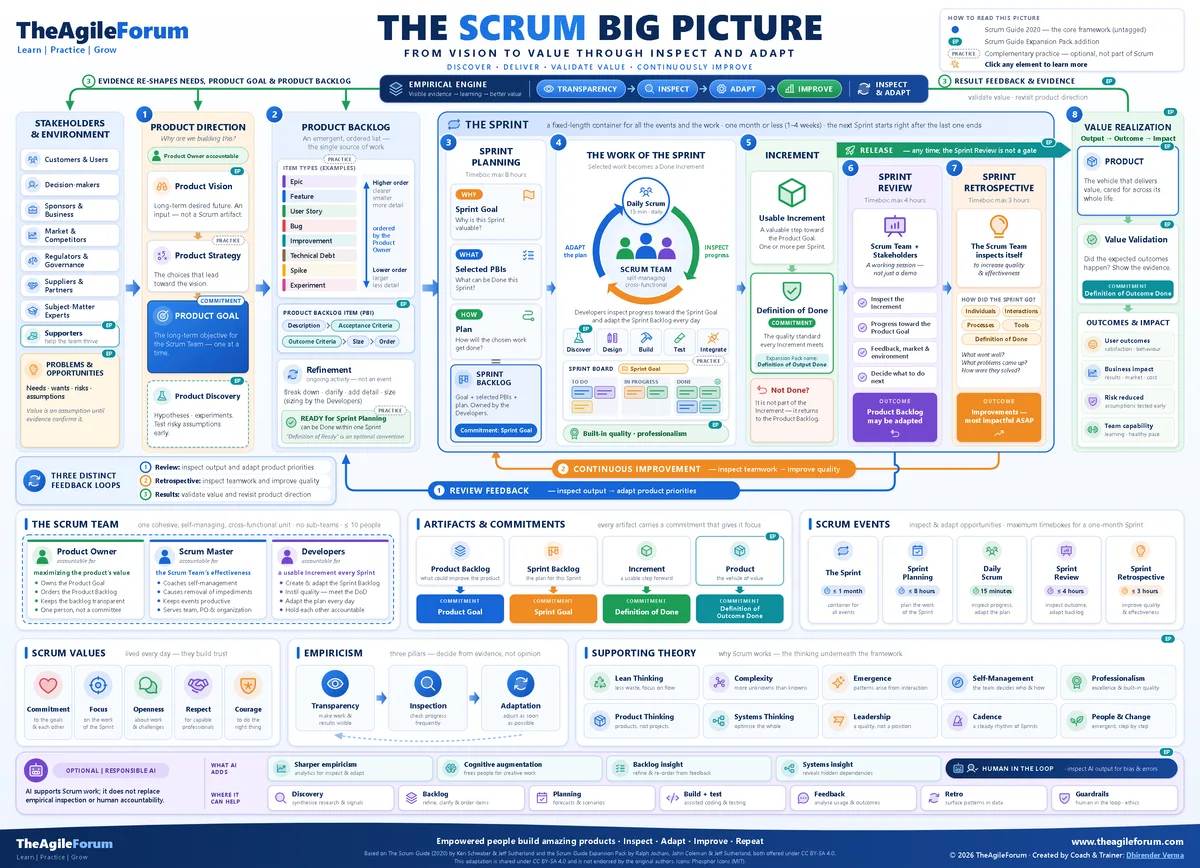
The Scrum Big Picture shows the Product Backlog, every event, the accountabilities and the three feedback loops on one page. Open the interactive Scrum Big Picture for 111 guided lessons and a 52-decision Sprint simulation.
Responsible AI: Use AI as an assistant, not a decision-maker: keep company data in approved tools and have people check every output.
Based on the Scrum Guide 2020 and the Scrum Guide Expansion Pack. Shared under CC BY-SA 4.0.
Step 2: Check your 41 Scrum Master skills
A two-day certification covers the minimum Scrum knowledge needed for the exam. Being an effective Scrum Master takes a much wider set of skills. Founder Dhirender Verma groups them like a periodic table into three domains. Tick the ones you can already show with an example.
Behavioural skills
Who you are with people.
- Leadership: Guide the team through servant leadership, without being its manager.
- Trust building: Build and keep the trust that open communication depends on.
- Motivation: Keep yourself and the team motivated through hard Sprints.
- Assertiveness: Balance confidence and respect when situations get difficult.
- Openness: Welcome different opinions and ideas, especially during change.
- Creativity: Find new ways to solve problems and inspire the team to explore.
- Efficiency: Do your own work well and set the standard for the team.
- Growth mindset: Help the team learn from challenges and stay resilient.
- Ethics: Act as the team's moral compass on business practices.
- Values: Live and defend the Scrum Values in practice.
- Body language: Read and use non-verbal communication, in person and on video.
- Empathy and emotional intelligence: Understand emotional needs and build real connections.
- Courage: Introduce change, make hard calls and own the outcomes.
- Respect: Build a culture where respect flows in both directions.
Contextual skills
How you work with the team and the organisation.
- Servant leadership: Lead by example, as a peer who actively supports the team's needs.
- Leading change: Treat resistance as normal and coach people through change.
- Impediment removal: Resolve dependencies and blockers, and teach the team to handle its own.
- Mentoring: Share experience and guidance to help people grow.
- Coaching: Ask questions that help the team find its own answers and become self-reliant.
- Teaching: Explain ideas objectively and encourage independent thinking.
- Team building: Build team dynamics, trust and collaboration.
- Facilitation: Design sessions where good ideas and decisions emerge.
- Communication: Keep information timely and connect the team with stakeholders.
- Active listening: Listen without judging or jumping to advice.
- Conflict resolution: Sense, manage and resolve conflict before it hurts delivery.
Technical skills
What you need to know about how work gets delivered.
- Agile values and principles: Apply the Agile Manifesto's values and principles in daily work.
- Lean thinking: See work as a value stream, remove waste and improve flow.
- Scrum accountabilities: Help everyone understand and use their accountability well.
- Scrum events: Make every event useful, from Sprint Planning to the Retrospective.
- Scrum artifacts: Support the Product Backlog, Sprint Backlog and Increment, with their commitments.
- Kanban: Use visual boards, WIP limits and flow metrics.
- Extreme Programming (XP): Know practices such as TDD, pairing and continuous integration.
- Scaling agile: Work across teams with frameworks such as SAFe.
- Software development lifecycle: Understand delivery models from waterfall to continuous delivery.
- Estimation: Keep forecasts realistic and workloads sustainable.
- Stakeholder relations: Connect the team, Product Owner and stakeholders effectively.
- Metrics and reporting: Use data to find improvements, not to judge individuals.
- Tooling: Help the team use Jira, Confluence and similar tools well.
- Business domain knowledge: Understand how the business makes money and serves customers.
- Customer centricity: Keep customer value at the centre of decisions.
- Design thinking: Use user-centred problem solving alongside Scrum.
Build the missing skills · Read the full article: What skills do I need to be a successful Scrum Master?
Step 3: Network with Agilists and attend a free webinar
A certificate can start a conversation; relationships keep it going. Come to a free live webinar with a question, meet Scrum Masters, Product Owners and Agile coaches, and leave with one idea to try.
Join The Agile Forum's next live webinar
Free Scrum Master, Agile project management and Product Owner sessions. Check the registration page for the next date and time.
- Ask a scenario-based question in the Q&A.
- Meet fellow learners and swap practical resources.
- Turn one insight into a practice experiment.
Register for the next free webinar
A simple networking rhythm
- Week 1: Attend a live webinar, write three takeaways and ask one question.
- Week 2: Talk to a practising Scrum Master about a real obstacle.
- Week 3: Join a Scrum community meetup or discussion and contribute one insight.
- Week 4: Publish a short reflection or case study and follow up with two peers.
A thoughtful first LinkedIn message: “Hi [Name], I enjoyed your perspective on [specific Scrum challenge]. I recently passed PSM I and am practising a Sprint simulation focused on [topic]. I'd value one suggestion on how you approach [real problem]. Thanks for sharing your experience.”
- Scrum Alliance events: Community gatherings, user groups and learning opportunities.
- Scrum.org community: Professional Scrum forums, webcasts and peer discussions.
- The Agile Forum Meetup groups: Local Agile, Scrum and career groups we host and support.
Step 4: Practise the job, not just the theory
The Scrum Master / Agile PM Live Project Mentorship is where you close the gap. You work on your own live project, on your laptop, with a coach beside you, so you leave with real experience to talk about.
What you practise
- Set up and run a real Jira project: backlog, boards, sprints, dashboards and JQL
- Facilitate every Scrum event through simulations and role-plays
- Combine Scrum, Kanban and XP practices
- Handle impediments, conflict and stakeholders through case studies
- Plan deployment and release, not just sprints
- Use AI tools across the delivery lifecycle
- Prepare interview stories from your own project work
What's included
- Live, instructor-led classes — not pre-recorded videos — with a recording of every class
- Your own live project on your laptop: sprints, backlog, Scrum events and stakeholder situations
- AI tools used across the delivery lifecycle
- Rejoin the next batch free if a busy week gets in the way
- Small cohorts of about 4–6 learners. Seats per batch are limited.
- No Cost EMI over 3, 6 or 9 months for learners paying in India
- Interview readiness: real examples to talk through, plus the optional Mock Interview Series
Your trainer: Dhirender Verma — SAFe® Program Consultant (SPC), Enterprise Agile Coach and founder of The Agile Forum — or an equivalently qualified trainer.
See the mentorship and batch dates · Ask a question on WhatsApp
Not ready to decide? Join a free live webinar first and ask your questions.
Prefer to practise on your own first? Free 90-day plan and practice Sprint
Days 1–30 · Build: Build a truthful foundation
Weeks 1–4 · knowledge, tools and your first simulation
- Revisit theory: Read the Scrum Guide and connect each accountability, artifact, commitment and event to the Scrum Big Picture.
- Set up a sandbox: Create a fictional product in Jira or a similar tool. Define the Product Goal, backlog, basic workflow and Definition of Done.
- Facilitate a practice Sprint: Run Sprint Planning, Daily Scrums, the Sprint Review and the Retrospective with peers, or role-play the conversations.
- Start community learning: Join a free webinar or discussion, ask a genuine question and record one insight you will apply.
What you can show: A working sample backlog, Sprint Goal, Definition of Done, one Done Increment description and your personal learning journal.
Days 31–60 · Apply: Apply coaching and improve flow
Weeks 5–8 · impediments, collaboration, quality and real feedback
- Investigate impediments: Keep a transparent impediment log, and tell removing impediments apart from doing the team's work for them.
- Design coaching experiments: Practise conflict handling, stakeholder alignment and keeping Developers self-managing.
- Add credible measures: Inspect Sprint Goal outcomes, cycle time, work-item age and defects, without ranking individuals.
- Run a second Sprint: Use Review feedback and one Retrospective experiment, then explain what changed and why.
What you can show: A two-Sprint case study with observations, experiments, decisions and updated evidence.
Days 61–90 · Prove: Prove readiness and choose your next track
Weeks 9–13 · portfolio, interview stories and specialisation
- Publish a safe portfolio: Write a clear two-page case study with screenshots, lessons, decisions and limitations.
- Practise interviews: Rehearse real situations as context → observation → intervention → impact → learning.
- Build relationships: Discuss your case study with two practitioners and use their feedback.
- Choose the next investment: Weigh deeper Scrum Master practice against Product Owner, delivery, product, leadership or an advanced certification.
What you can show: A portfolio link, five evidence-backed interview stories, peer feedback and a six-month development goal.
Your 10-action checklist
- Read the Scrum Guide and explain the three Scrum commitments.
- Study the Scrum Big Picture and its three feedback loops.
- Finish at least five Scrum Academy lessons and their knowledge checks.
- Set up a fictional project, backlog and Definition of Done.
- Write a useful Sprint Goal and run a Sprint Planning role-play.
- Simulate a Sprint Review with real questions from stakeholders.
- Run a Retrospective and test one improvement in the next Sprint.
- Join one free webinar and one community discussion.
- Publish an honest, anonymised or simulated case study.
- Practise five situational interview answers with feedback.
The ShopEase practice Sprint
Product Goal: make checkout reliable and easy. Example Sprint Goal: “Help shoppers recover from a failed payment without losing their cart.” A Definition of Done might cover automated tests, security checks, code review, integration and usable behaviour. The team's exact Definition of Done should be explicit and fit the product.
- Product discovery: Interview imaginary shoppers, clarify the cart-loss problem and write one desired outcome.
- Sprint Planning: Explain why this Sprint matters, select work toward a cohesive Sprint Goal and plan how to build it.
- Daily Scrum: Developers inspect progress toward the Sprint Goal and adapt the next 24 hours of work.
- Build a Done Increment: Collaborate, test, integrate and check quality against the Definition of Done.
- Sprint Review: Discuss the outcome with stakeholders, examine the Increment and adapt the Product Backlog.
- Sprint Retrospective: Inspect how the team works and pick one actionable quality or collaboration improvement.
Practise the 52-decision Sprint simulation
Step 5: Prove it: portfolio and interviews
Interviewers trust specific stories from real work. Turn what you practised into a short portfolio and answers you can give with confidence. Never present a simulation as paid job experience.
Your six-piece portfolio
- Product problem, audience, desired outcome and constraints.
- Product Goal, Product Backlog examples and the reasons for their order.
- Sprint Goal, a sample Sprint Backlog and the Definition of Done.
- Screenshots or exports of the Jira board and workflow, with explanations.
- Sprint Review insights, a Retrospective experiment and evidence of adaptation.
- Self-critique: what the simulation cannot show, and what you would validate on a real team.
Practise these interview questions
- The Product Owner wants to add urgent work mid-Sprint. What do you do?
- Understand the new need and its impact. Help the Product Owner and Developers inspect whether the Sprint Goal can stay intact and what trade-offs are needed. Do not treat Sprint scope as frozen, and do not quietly abandon the Sprint Goal.
- Your Daily Scrum has turned into a 45-minute status meeting. What changes?
- Ask the Developers whether the meeting helps them inspect progress toward the Sprint Goal. Coach a focused 15-minute Daily Scrum, move problem-solving to follow-up conversations and let the Developers own the event.
- The team finishes stories but stakeholders see no improvement. Why?
- Separate output from outcome. Inspect Product Goal alignment, user evidence and Review feedback. Encourage smaller hypotheses and meaningful measures rather than maximum ticket throughput.
- Two team members are in conflict and delivery suffers. How do you intervene?
- Listen to both people, clarify shared goals and boundaries, make the impact visible, facilitate a respectful conversation and follow up on agreements, without acting as judge or team manager.
- Velocity rose, but escaped defects increased. Is that success?
- No single metric proves success. Inspect quality, the Definition of Done, rework, sustainability and customer impact. Invite the team to improve its technical practices, and do not rank individuals by velocity.
More interview questions · Live mock interviews
Step 6: Your next certification: pick by role, not by badge
After PSM I, the most useful next step for most learners is a SAFe certification that matches the job they want. SAFe is widely used by organisations that run many teams, which is where most Scrum Master and Agile PM roles sit.
- SAFe Scrum Master (SSM) for Scrum Master · Agile Project Manager: Takes your Scrum foundation to a team of teams: PI Planning, iteration events in a SAFe context, coordinating dependencies across an Agile Release Train, flow, DevOps basics and AI-supported facilitation. Best for Scrum Masters, Agile Project Managers and team leads who want roles in multi-team organisations. See SAFe Scrum Master training
- SAFe Agilist (Leading SAFe) for Senior leader · manager · programme lead: Lead change across the enterprise: SAFe principles and values, value streams, forming Agile Release Trains, running PI Planning, Lean portfolio thinking and connecting strategy to delivery. Best for managers, delivery and programme leads, coaches and senior roles, and a foundation for the Release Train Engineer path. See Leading SAFe training
- SAFe Product Owner / Product Manager (POPM) for Product Owner · Product Manager: Own value in a multi-team setting: product strategy, features and stories, PI objectives, backlog refinement across teams, customer centricity and working with stakeholders. Best for Product Owners, Product Managers, business analysts and anyone moving from Scrum Master into product. See SAFe POPM training
PSM certificates are lifetime, but your practical knowledge needs upkeep. Scrum.org says Professional Scrum certifications do not expire and need no renewal fee or SEUs. That is not a reason to stop learning: revisit the Scrum Guide, discuss complex cases, practise with teams and challenge your assumptions regularly.
Also worth knowing
- PSM II and PSM III, when experience supports it: Scrum.org's advanced assessments test applied judgement in complex scenarios. They suit experienced Scrum Masters; they are not a quick follow-up to PSM I. Scrum.org PSM II details
- PSM I → A-CSM is now possible: Scrum Alliance now accepts PSM I or PSM II in place of CSM for A-CSM. You still need full course attendance and at least 12 months of Scrum Master work experience, and the path does not cover CSP-SM or other advanced courses. Scrum Alliance's PSM to A-CSM policy
Free resources to keep learning
Watch: The Scrum Big Picture explained
- Interactive Scrum Big Picture: 111 guided lessons and a 52-decision Sprint simulation.
- Free live webinar: Scrum Master and Product Owner sessions with Q&A.
- Webinar recordings: Career paths, interviews and role clarity.
- Meetup groups: Local Agile, Scrum and career communities.
Questions you may have
- What is the best certification after PSM I?
- It depends on the role you want. For Scrum Master and Agile Project Manager roles, SAFe Scrum Master adds multi-team skills such as PI Planning. For senior leaders and managers, Leading SAFe (SAFe Agilist) fits best. For Product Owner and Product Manager roles, SAFe POPM is the natural next step.
- Does PSM I expire? Is renewal required?
- No. Scrum.org says its Professional Scrum certifications are lifetime credentials and need no renewal fee or SEUs.
- Is PSM II compulsory after PSM I?
- No. PSM II is an optional advanced assessment. PSM I is recommended preparation, but there is no rule that you take PSM II next. Experience with difficult situations is the better preparation.
- Can PSM I holders take A-CSM without CSM?
- Yes. Scrum Alliance now accepts PSM I or PSM II, earned at any date, in place of CSM for A-CSM. Full course attendance, at least 12 months of Scrum Master work experience and the trainer's other requirements still apply, and the path does not cover CSP-SM or other advanced courses.
- Can I pass PSM II just by studying mock questions?
- Memorising alone is risky. The assessment tests applied judgement in complex scenarios. Learn to explain actions in terms of empiricism, accountabilities, self-management, value, coaching and evidence.
- What is the best way to prepare for PSM III?
- Build extensive real Scrum Master experience, coaching depth and the ability to explain decisions in complex organisational situations. PSM III includes essay answers reviewed by Scrum experts and is best seen as an expert-level milestone.
- Does Scrum require Jira, story points or a Definition of Ready?
- No. Jira, estimation techniques and a Definition of Ready are optional practices. The Scrum Guide defines three artifacts, each with a commitment; the Definition of Done is one of those commitments.
- I passed PSM I but have no Scrum Master job. What now?
- Practise with a clearly disclosed simulation or supervised volunteer work, facilitate peer discussions, write a case study and interview with honest examples. A certificate alone is rarely enough professional evidence.
Turn your PSM I into real Scrum Master experience
Join a small live cohort, run your own live project with a coach, and leave with the skills and stories interviewers look for.
See the mentorship and batch dates · Ask a question on WhatsApp
Sources and transparency
Information checked on 19 November 2026. Certification policies and event dates may change; the official providers decide credential requirements. The Agile Forum is an independent learning provider and this page is not endorsed by Scrum.org or Scaled Agile. The mentorship is hands-on job preparation, not a certification.
- Scrum.org · PSM I
- Scrum.org · PSM II
- Scrum.org · PSM III
- Scrum Alliance · PSM to A-CSM entry policy
- Scrum.org · Community
- Scrum Guide 2020
- Scaled Agile Framework (SAFe)
Also read: What after CSM? · What after CSPO? · What after PSPO I?